
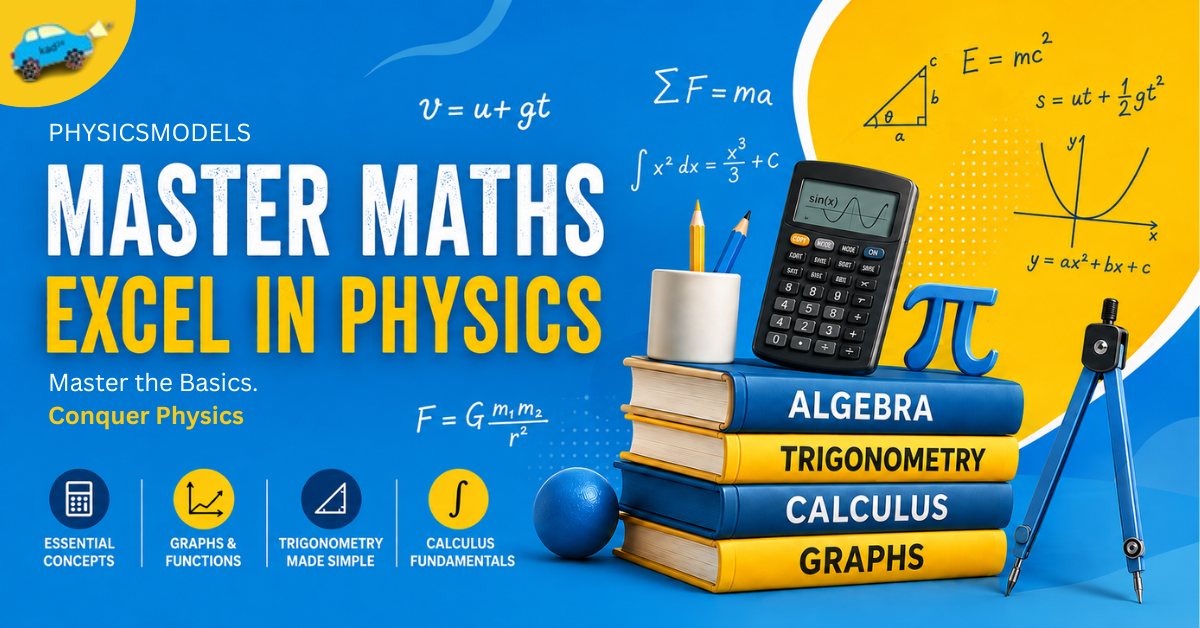
Basic Maths for Physics: The Essential Foundation Every Student Needs
- Posted by Kaustubhan Srivathsan
- Date August 5, 2026
Physics is often described as the language of nature, but mathematics is the language of physics. Without a solid mathematical foundation, understanding concepts such as motion, electricity, waves, and mechanics becomes much more difficult. Whether you are a Class 11 or Class 12 student, preparing for competitive exams like JEE or NEET, or simply looking to strengthen your fundamentals, learning basic maths for physics is the first step toward mastering the subject.
Before diving into advanced physics concepts, students should focus on basic maths for physics, as it forms the foundation for solving numerical problems, understanding equations, and interpreting scientific concepts with confidence.
Many students struggle with physics not because the concepts are difficult but because they lack confidence in the mathematical tools used throughout the subject effectively. Topics like algebra, trigonometry, graphs, differentiation, and integration appear repeatedly in almost every chapter of physics. Building these skills early makes problem-solving faster, easier, and more accurate.
Understanding the connection between mathematics and physics helps students build a strong foundation. Explore the important mathematical topics required for physics, avoid common learning mistakes, and discover effective ways to improve your skills.
Before diving into advanced physics concepts, students should focus on basic maths for physics, as it forms the foundation for solving numerical problems, understanding equations, and interpreting scientific concepts with confidence.
Many students struggle with physics not because the concepts are difficult but because they lack confidence in the mathematical tools used throughout the subject effectively. Topics like algebra, trigonometry, graphs, differentiation, and integration appear repeatedly in almost every chapter of physics. Building these skills early makes problem-solving faster, easier, and more accurate.
Understanding the connection between mathematics and physics helps students build a strong foundation. Explore the important mathematical topics required for physics, avoid common learning mistakes, and discover effective ways to improve your skills.
Why Is Basic Maths for Physics Important?
Many beginners believe physics is all about memorising formulas. In reality, physics is about understanding relationships between physical quantities and applying mathematical principles to solve real-world problems. A strong understanding of basic maths for physics enables students to:- Solve numerical problems accurately
- Understand equations rather than memorise them
- Interpret graphs and experimental data
- Build confidence in solving complex Physics questions
- Prepare effectively for board exams and competitive entrance tests successfully.
Understanding Mathematics in Physics
The role of mathematics in physics goes beyond calculations. It helps describe natural phenomena using equations, models, and logical reasoning clearly For example:- Newton’s Second Law is expressed as F = ma
- Gravitational Force follows an inverse square relationship
- Build mathematical models
- Explain experimental observations
- Predict future outcomes
- Solve engineering and scientific problems
Importance of Maths in Physics
The importance of maths in physics becomes clear as students progress through higher classes. Here are some key major reasons why mathematics is indispensable:- It Improves Problem-Solving Skills
- It builds conceptual understanding.
- It Saves Time During Exams
- It Improves Accuracy
Why Is Maths Important in Physics?
One of the most common questions students ask is why maths is important in physics. The answer is simple. Physics studies motion, energy, electricity, light, sound, and forces. These quantities change continuously and interact with each other. Mathematics helps measure these changes precisely. For example:- Calculating speed requires division.
- Finding acceleration requires algebra.
- Determining projectile motion requires trigonometry.
- Analysing motion graphs requires calculus.
Maths Required for Physics
Many students worry about the maths required for physics before entering Class 11. Fortunately, you don’t need advanced university mathematics to begin learning physics effectively. The essential topics include:| Mathematical Topic | Used For / Includes | Example / Notes |
| Algebra |
• Rearranging equations • Solving simultaneous equations • Working with variables |
Formula: If V = IR Then R = V ÷ I |
| Geometry |
• Measuring angles • Understanding vectors • Area and volume calculations |
Essential for solving problems involving shapes, motion, and space in physics. |
| Basic Arithmetic |
• Fractions • Percentages • Ratios • Scientific notation |
These skills are used in almost every physics chapter, making them the foundation for calculations and problem-solving. |
Trigonometry in Physics
One of the most important mathematical tools is trigonometry in physics. It helps calculate:- Forces acting at angles
- Projectile motion
- Inclined planes
- Wave behaviour
- Circular motion
Tips for Learning Trigonometry
- Memorise standard angle values.
- Practise right-angle triangle problems.
- Understand sine, cosine, and tangent relationships.
- Learn vector resolution.
Graphs in Physics
Another important topic is graphs in physics. Graphs allow students to visualise relationships between different physical quantities accurately. Instead of reading numbers individually, graphs help identify patterns quickly and easily. Examples include:- Distance vs Time
- Velocity vs Time
- Current vs Voltage
- Pressure vs Volume
Types of Graphs in Physics
Students should also understand the different types of graphs in physics because they appear frequently in board examinations. Some common graph types include:| Linear Graphs | Curved Graphs | Exponential Graphs | Parabolic Graphs |
|
Used when: Two quantities increase proportionally. Example: Distance vs Time at constant speed. |
Used when: One variable changes non-linearly. Example: Free fall motion. |
Used in: Radioactive decay Charging capacitors Cooling processes |
Seen in: Projectile motion. Note: Learning how to interpret slopes, intercepts, and areas under graphs greatly improves conceptual understanding. |
Differentiation in Physics
As students move into advanced topics, differentiation in physics becomes increasingly important. Differentiation helps determine the rate at which quantities change. Examples include:- Velocity = Rate of change of displacement
- Acceleration = Rate of change of velocity
- Motion analysis
- Oscillations
- Electric fields
- Magnetic fields
Integration in Physics
Alongside differentiation, integration in physics plays a vital role. Integration is essentially the reverse of differentiation. It is commonly used to calculate:- Displacement from velocity
- Work done by variable force
- Electric potential
- Centre of mass
Should You Take an Online Maths Course for Physics?
Many students choose an online maths course for physics to strengthen their mathematical foundation before tackling advanced Physics topics. Online learning offers several advantages:- Learn at your own pace
- Replay difficult concepts anytime
- Visual explanations improve understanding
- Structured lessons build concepts gradually
- Practice exercises reinforce learning
Common Mistakes Students Make
Avoid these common mistakes while learning Physics mathematics.- Memorising Without Understanding – Always understand why a formula works.
- Ignoring Units – Correct units are essential in every calculation.
- Skipping Graph Practice – Graphs appear frequently in examinations.
- Weak Algebra Skills – Most Physics equations require rearranging formulas.
- Not Practising Numericals – Reading theory alone cannot improve problem-solving ability.
Expert Tips to Master Physics Mathematics
The best way to improve basic maths for physics is to practise consistently, revise mathematical concepts regularly, and apply them while solving real Physics problems instead of learning formulas in isolation. Follow these practical tips to strengthen your mathematical skills.- Revise algebra regularly.
- Learn trigonometric identities thoroughly.
- Practice graphs every week.
- Solve numerical problems daily.
- Understand derivations instead of memorising them.
- Use visual learning resources whenever possible.
- Maintain a separate notebook for important formulas.
- Focus on conceptual clarity before speed.
Build a Strong Foundation in Physics with PhysicsModels
Mastering basic maths for physics is one of the smartest investments any student can make. From algebra and trigonometry to graphs, differentiation, and integration, every mathematical concept strengthens your understanding of physics and improves problem-solving skills.At PhysicsModels, our Maths Starters course is designed to help students build these essential mathematical foundations before diving into physics. Whether you’re preparing for Class 11, Class 12, or JEE Main or simply want to strengthen your basics, PhysicsModels provides structured lessons that make learning maths for physics simple, practical, and confidence-building. Start your journey with PhysicsModels today and develop the mathematical skills needed to succeed in physics.

Engineer MBA (IIM Calcutta), with 42+ years of rich experience in topclass companies in Automotive R&D, and others.
You may also like
About Physicsmodel
October 20, 2022
