
Friction causes Rolling – Ball rolling on a surface – Pure Rolling without sliding, etc
Get a feel for Rolling Motion and its nuances.
1) A Car Tyre having Pure Rolling on horizontal surface without SLIDING/SLIPPING ;
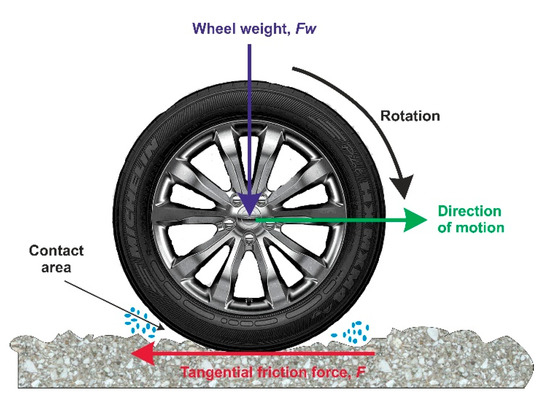
The friction force acts in rearwards direction to the direction of travel of the tyre.
2) A Car Tyre rolling down a slope with PURE ROLLING without SLIDING/SKIDDING:
The car is moving linearly in translation, whereas only the Tyre is rotating (axis of rotation being the centre point) .
The Tyre Centre axis does not rotate, the centre axis of the Tyre is moving forward linearly in +X axis, the tyre’s shaft is connected to an axle which is connected rigidly to the car’s body, that is how the car moves forward along X axis.
When the car (and hence tyre) moves down a slope or inclined plane, without acceleration by driver, PURE ROLLING WITHOUT SLIDING happens, when it is rolling down under the influence of its OWN WEIGHT, not Engine power or Motor power.
Coming to Theory, the friction co-efficient between the road surface and car tyre material causes the tyre to rotate. Usually the coefficient for a good tyre = 1 . Also, It is the Static Force of Friction, acting on the radius of Tyre, which causes TORQUE.
{Force of static friction (at the ground )} x (Radius of tyre)} = Torque . Units N-m
Below is an image where yellow arrow shows direction of travel of car . The arrow applies equally to all 4 tyres.
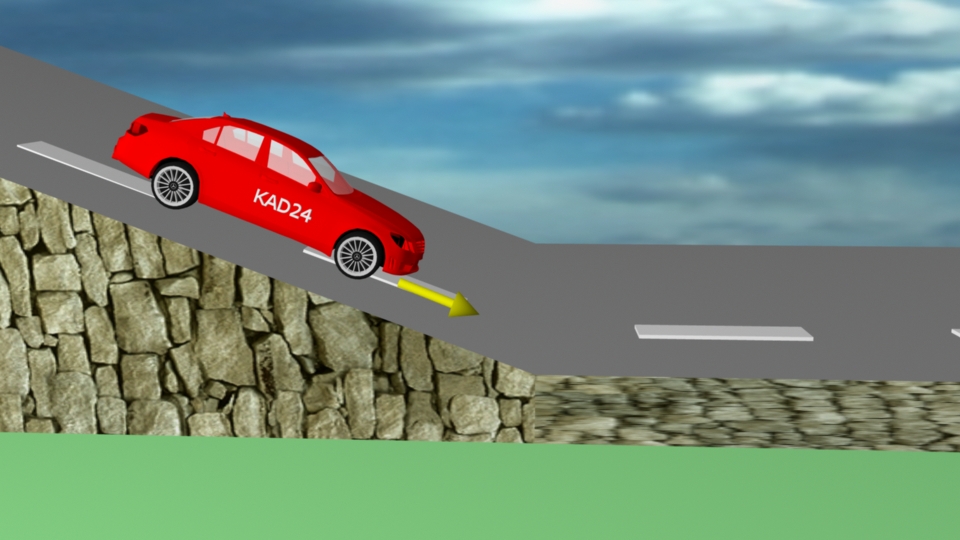
A close look at a tyre in PURE ROLLING :- Let radius of Tyre = R , the tyre will rotate by 2ΠR , its circumference in one rotation, and this will be the same exact LINEAR distance completed by the car as well as Tyre Centre , provided there is no slipping / skidding between the tyre and road surface.
In image below, the Tyre is moving forward in translation, and the friction at the ground contact point , acts in rearward/backward direction, only when it is PURE ROLLING without sliding/slipping.
3) On the other hand, when the tyres are Accelerated or Braking is applied by driver of the car :
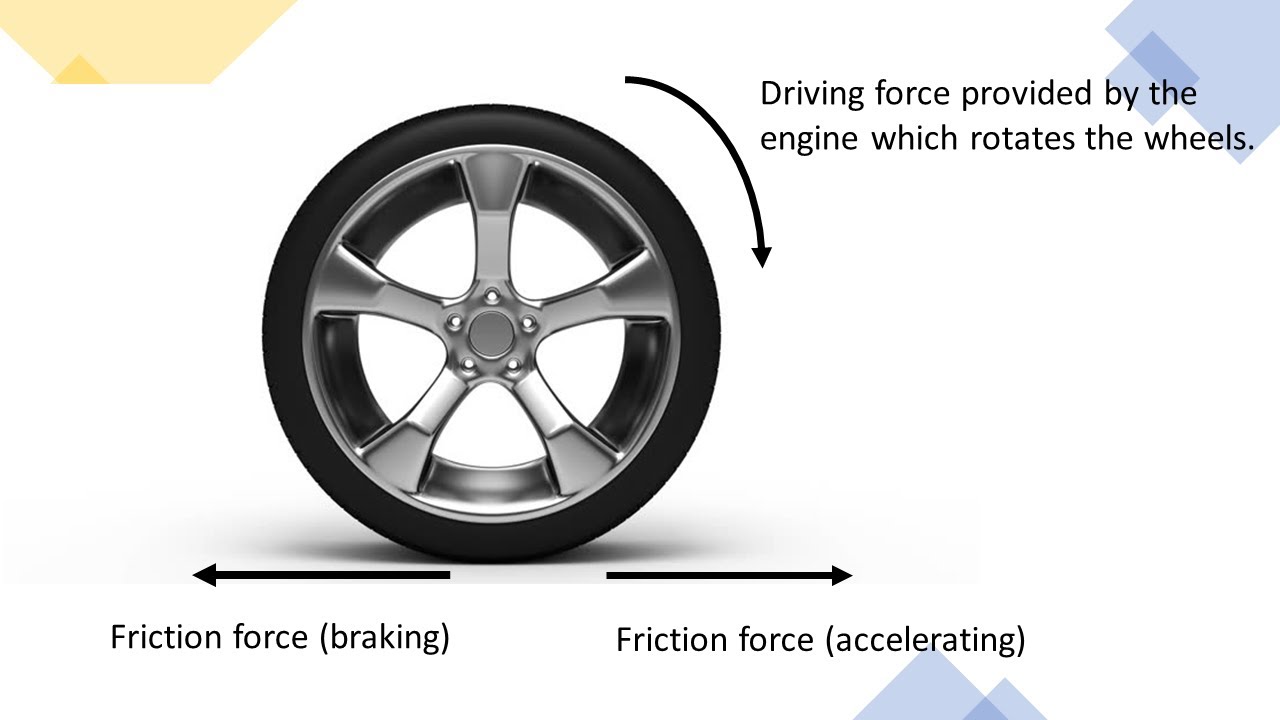
The motion is called ROLLING + SLIDING . The friction force direction changes opposite tom when there is PURE Rolling only.
The tyre material no longer has velocity=0 at the contact area with road. That is why the Friction Force acts in opposite direction to prevent the sliding motion
a) FORWARD direction of Friction Force in case of Acceleration. – Tyre contact patch with road has velocity vector in rearwards direction
b) REARWARD direction of Friction Force in case of Braking – Tyre contact patch with road has velocity vector in Forward direction
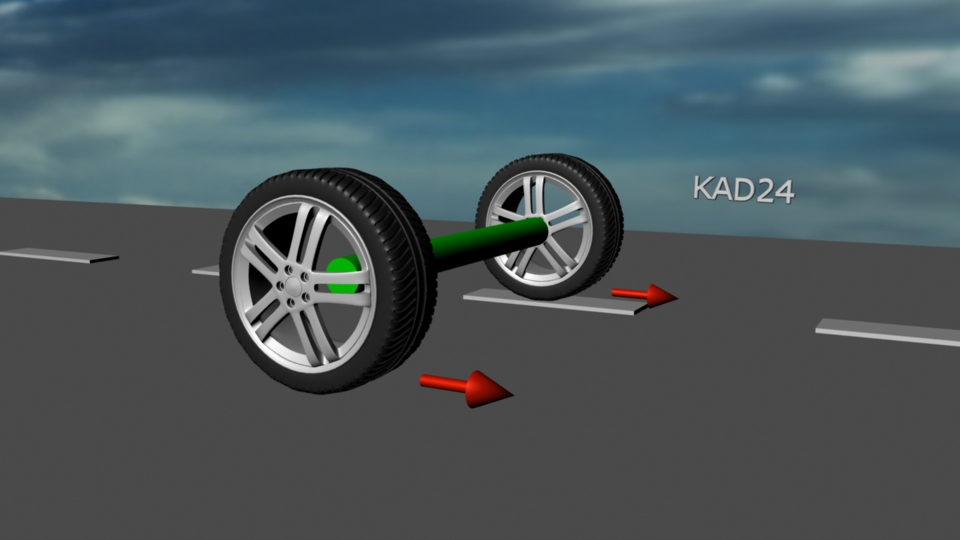
Below image is another image for tyres undergoing Acceleration : Friction Force direction (red arrows) are FORWARD , same as direction of travel . WHY? Because at the contact patch with road, tyre velocity is backwards, hence friction is Forward.
2) A Spherical BALL rolling and moving down a SLOPE:-
What’s the Difference between a Tyre, Sphere (Ball) and Solid Rigid Cylinder when it comes to Rolling motion ?
The main difference is not Mass, it is the Contact Point with ground which defines friction and how it acts, and Moment of Inertia.
- TYRE: has a contact patch, it is an area. Because tyre has air pressure, and a pneumatic tyre compresses a little bit where it touches the ground. Tyre is like a Cylinder but is filled with air, hence you can say it is a flexible cylinder
2. BALL : It has a Contact POINT. Not an area, not a line
3. SOLID RIGID CYLINDER ?? It will have a contact as a Straight LINE . Not a point, not an area patch
Now let’s come to Sphere
Let M= mass of ball, and g= acceleration due to gravity
There are 2 distinct motions :-
A) Rotation motion about the ball’s own axis, also its Centre of Mass (CM) in case of “Pure Rolling without Slipping”
B) Translational motion / Linear motion of the ball’s Centre of Mass (CM) along a straight line down the inclined plane
The basic principle of the Ball’s CM’s motion down the inclined plane, is similar as that of a Rectangular Block sliding down an Inclined Plane.
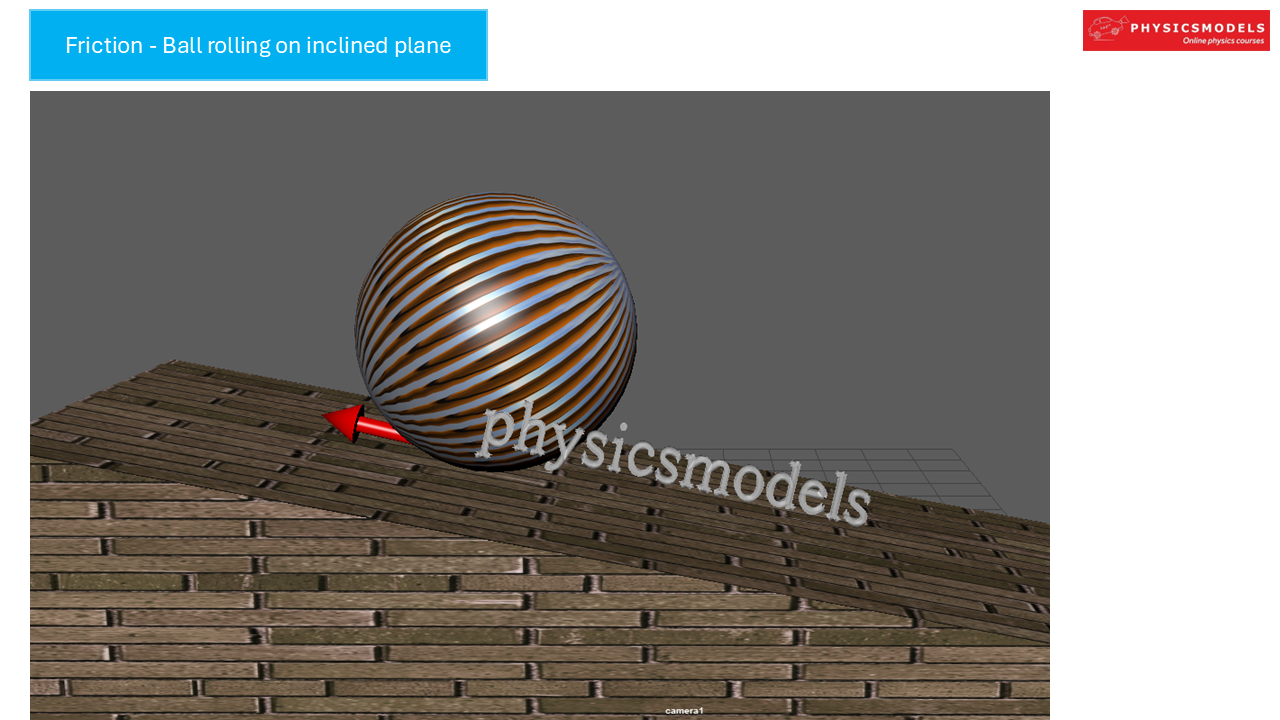
See diagram below. It is the weight of the ball, Mg , which acts vertically downward at all times, is the force that causes the two motions –
A) Translation (down the plane) and
B) Rolling /Rotation motion about the axis of the ball, which is same as its Centre of Mass.
One component of weight Mg acts through the Centre of Mass of the Ball . This component of Force is acting downwards at same angle as the slope of the Inclined Plane. The other component of weight Mg acts at the contact point of ball and inclined plane, and becomes the Normal Force acting upwards at an angle.
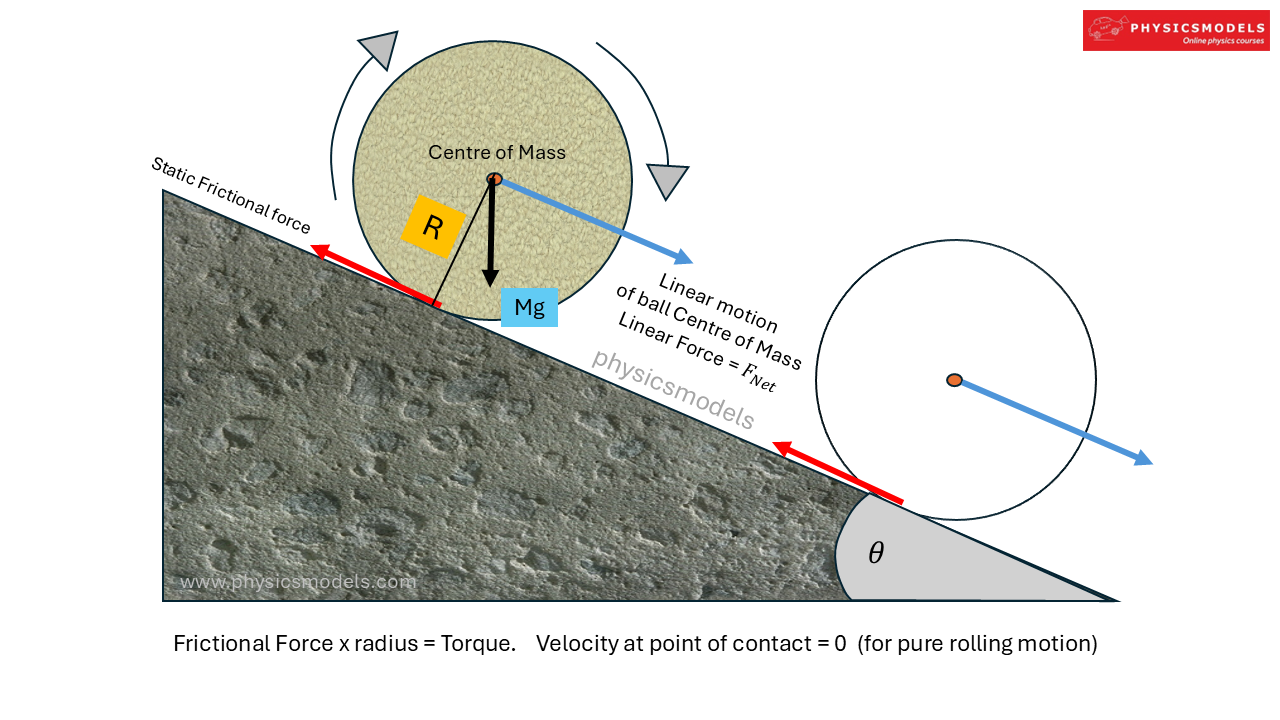
Understand what causes ROLLING or ROTATION -> It is the TORQUE.
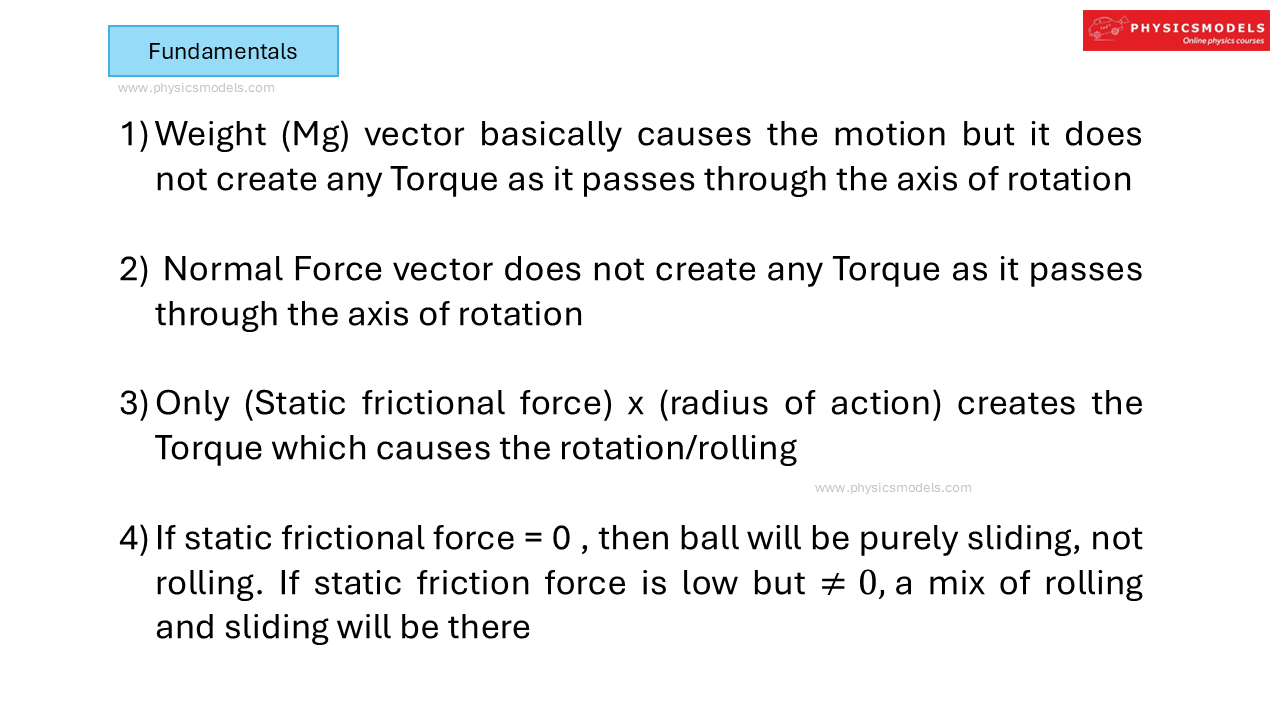
What Causes Torque? It is the Frictional Force, static frictional force.
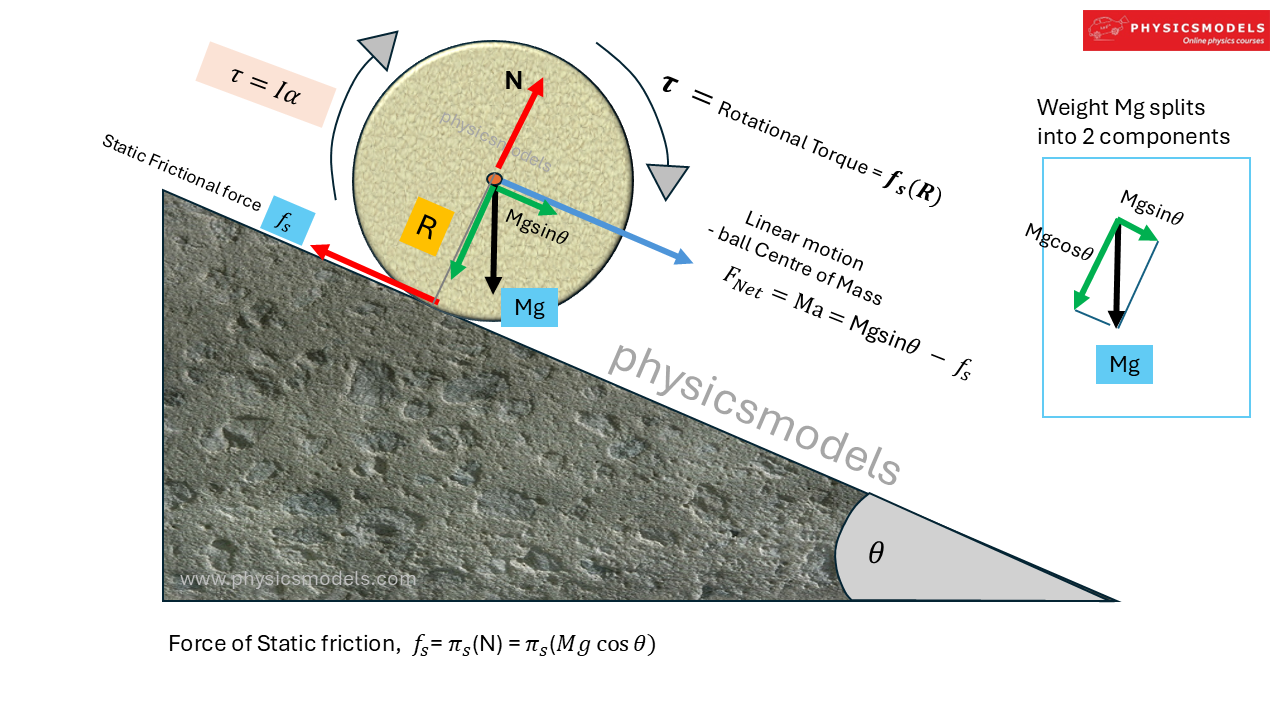
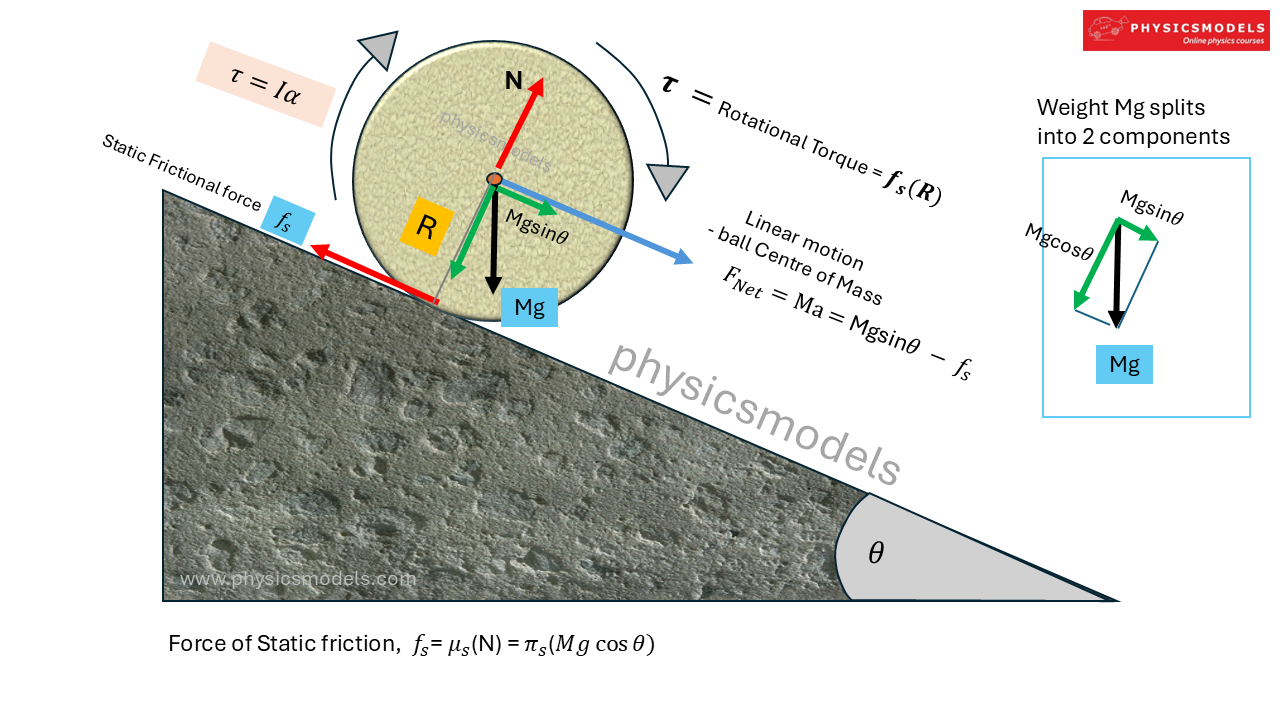
In sketch below, you can see that if the angle of Inclined plane is made more steep, the Linear acceleration increases. The weight Mg is not changing, but due to the angle, the component of the Weight Force along the plane becomes bigger as a vector. Compare this vector with the previous sketch where the angle of inclined plane was smaller.
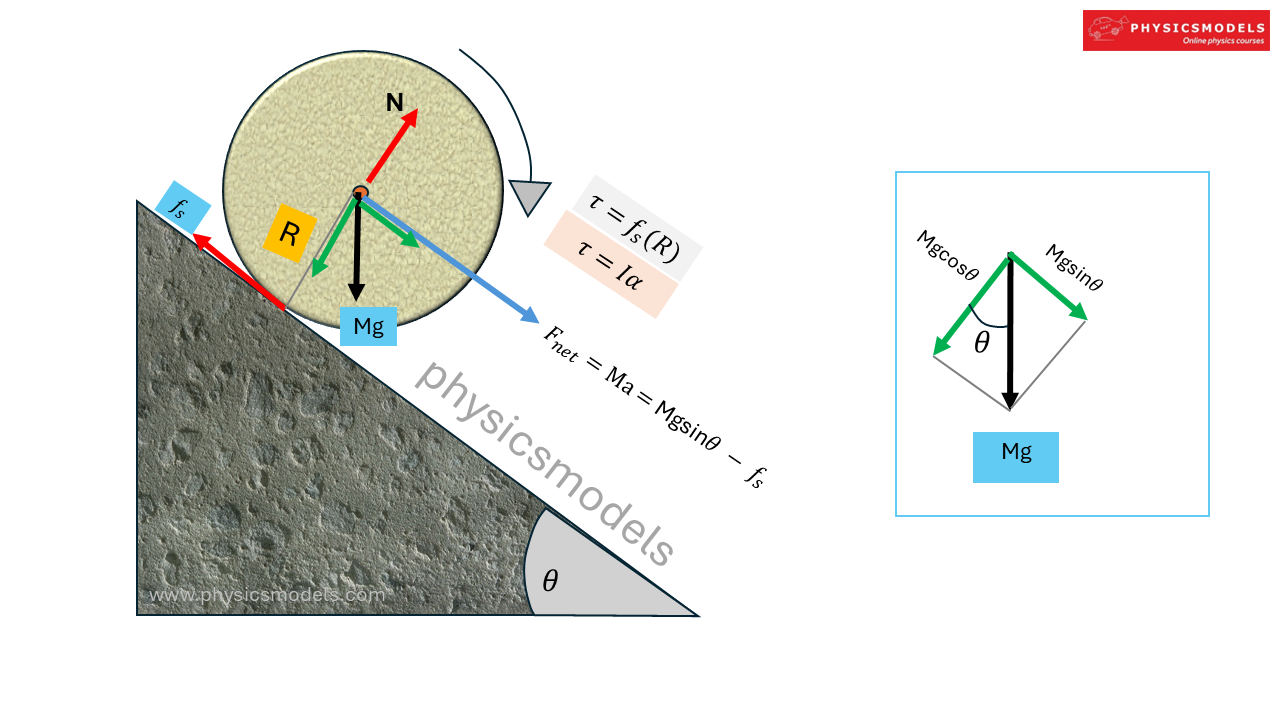
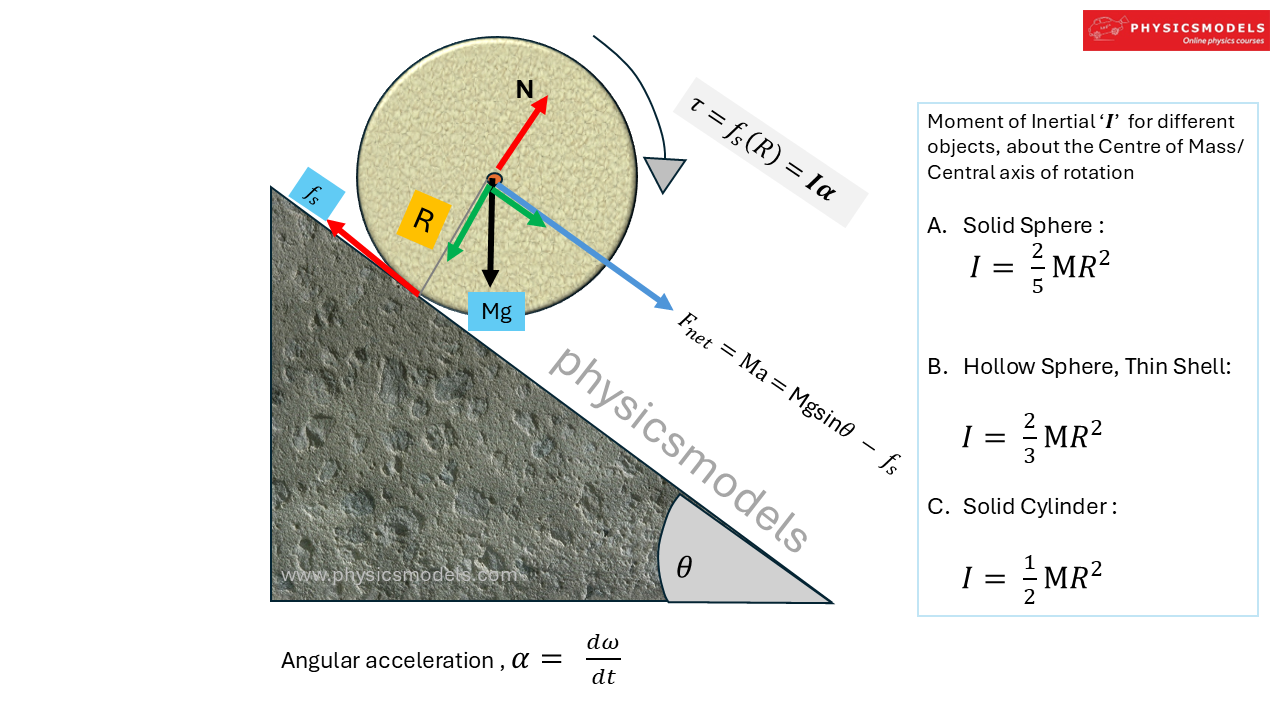
Now, in below sketch, understand the relationship between the ball’s linear acceleration and the ball’s Angular Acceleration, a tricky one.
Also given is the Moment of Intertia of various shapes of objects, taken about their Axis of rotation which coincides with the Centre of Mass.
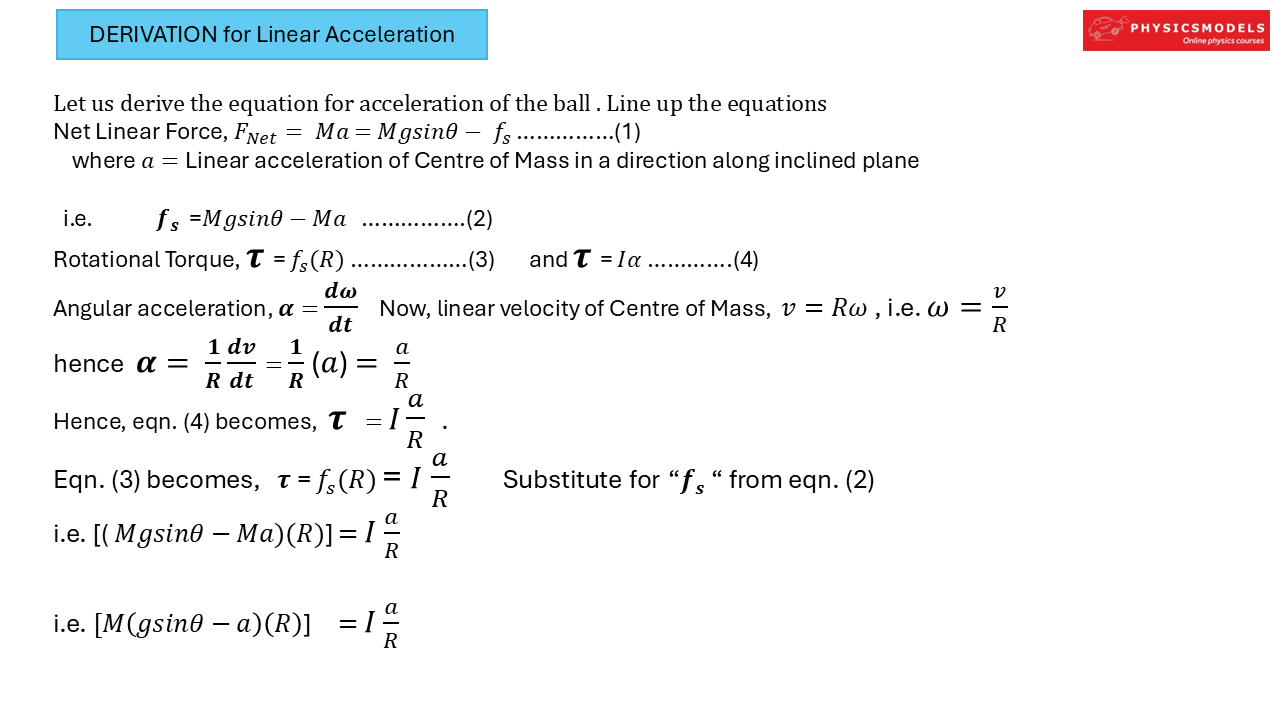
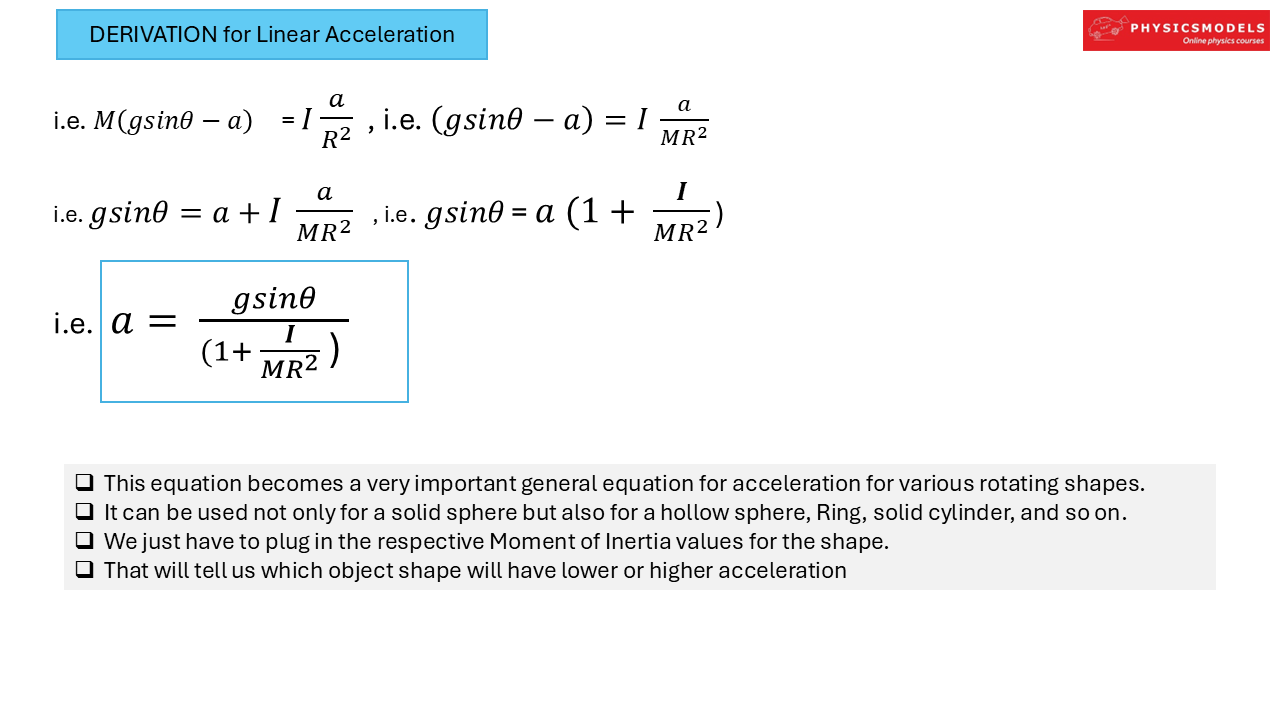
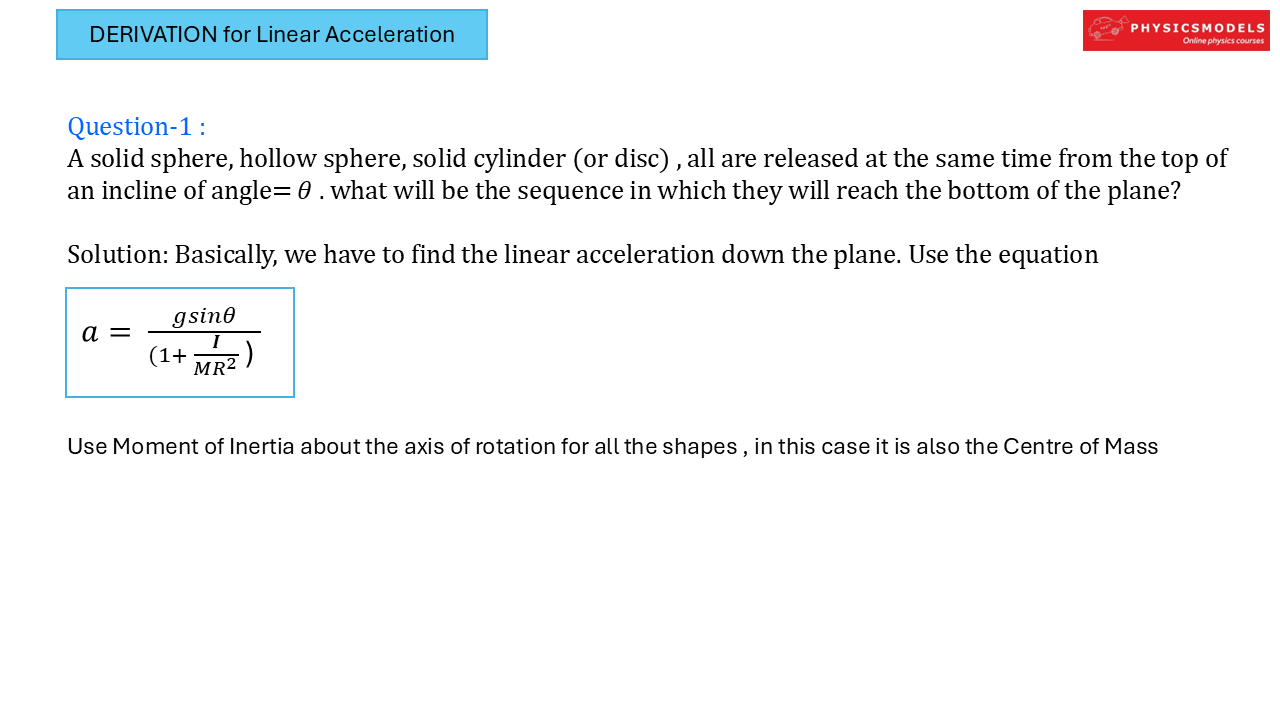
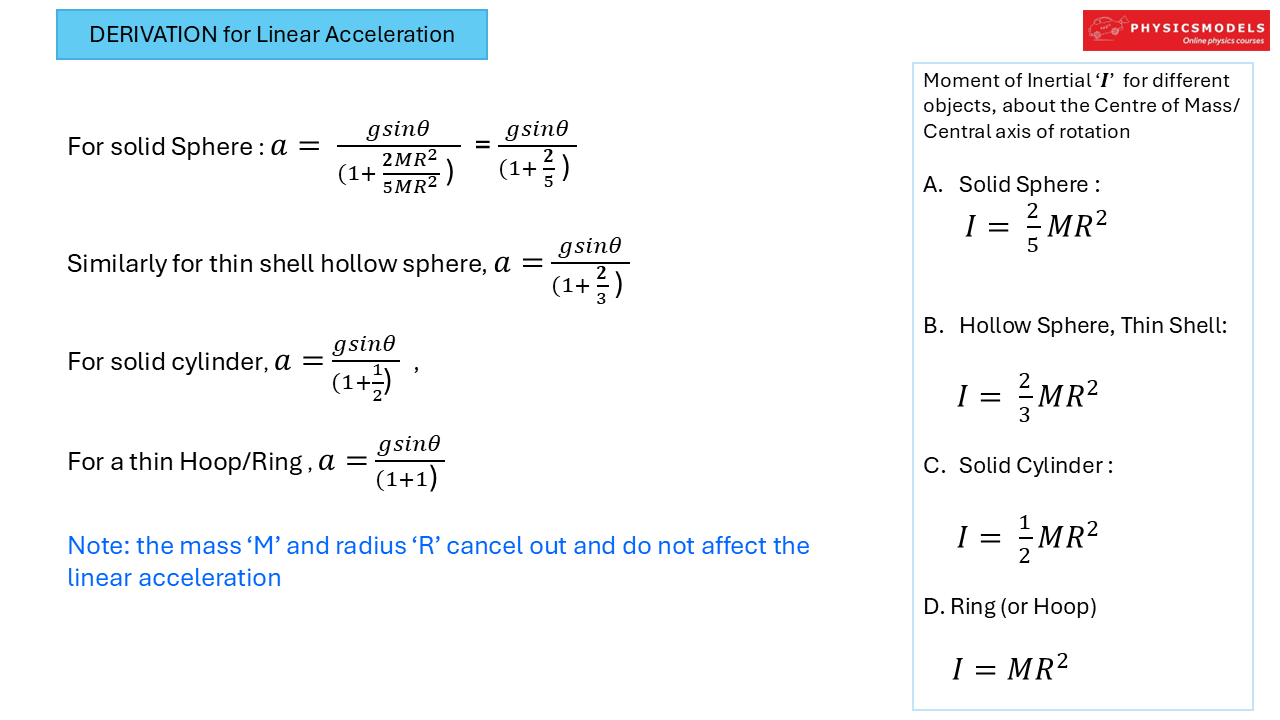
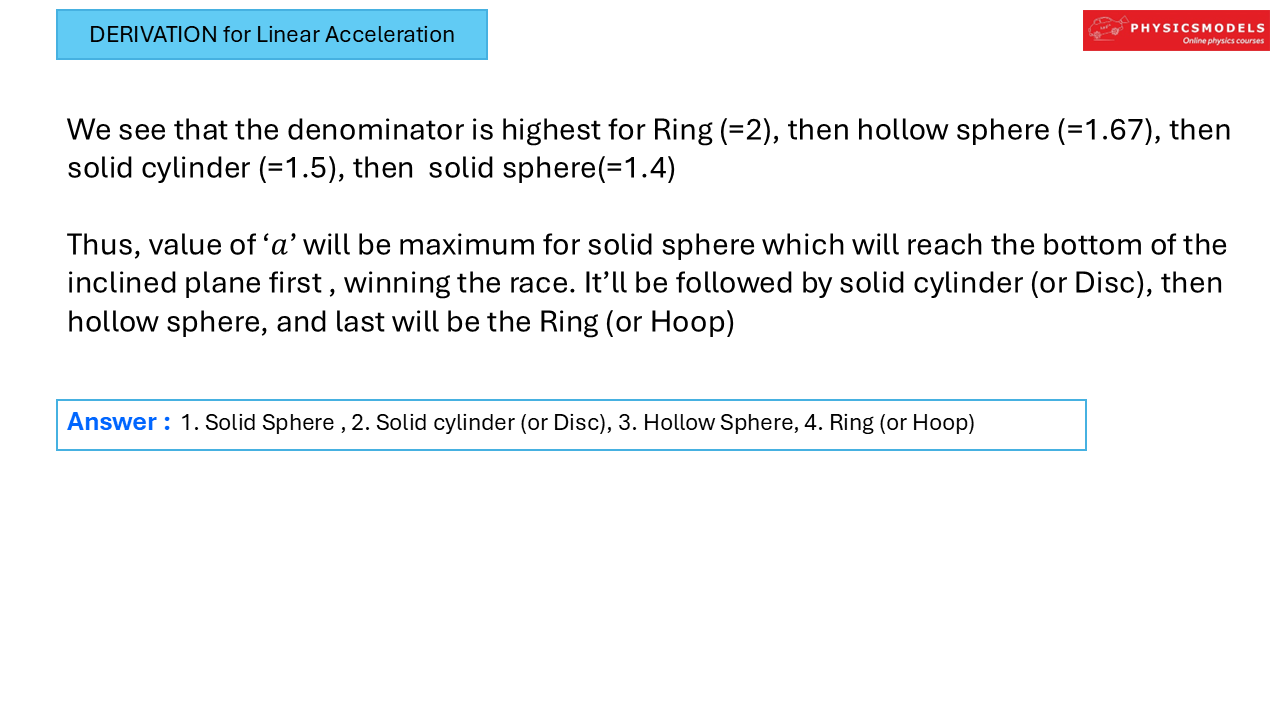
Let us try another question
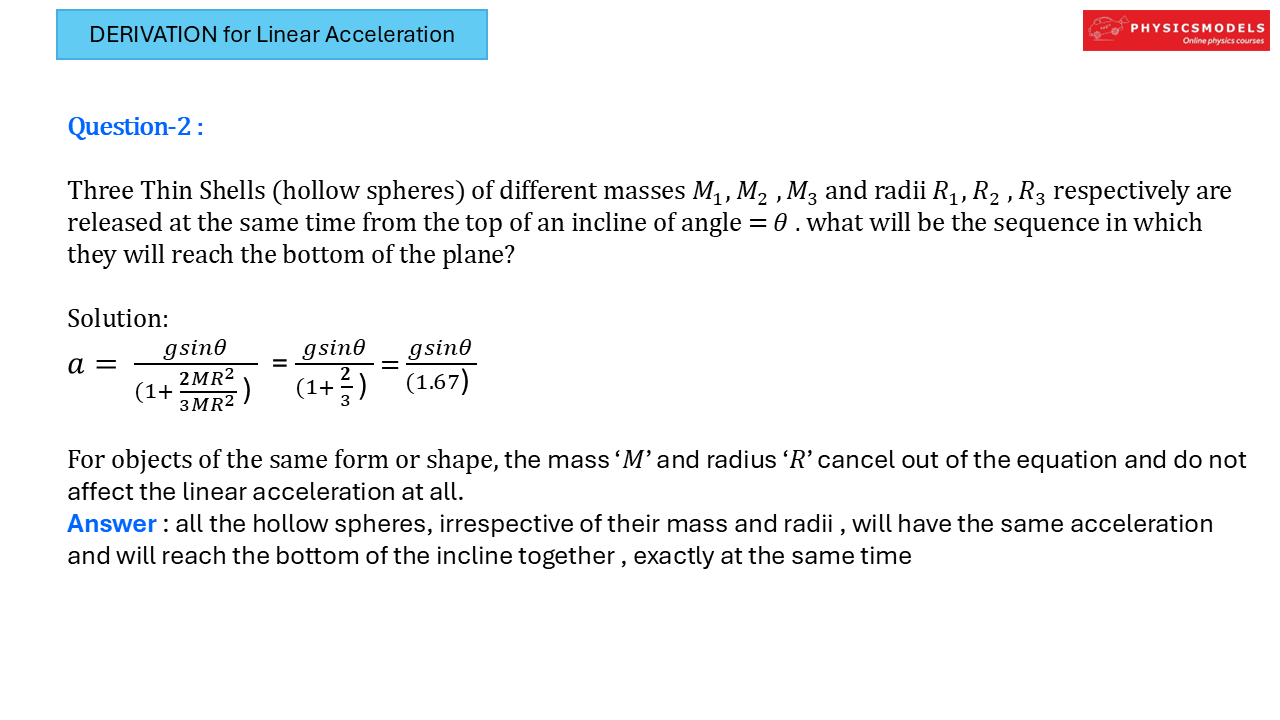
TWO SPHERES having PURE ROLLING when moving down an inclined plane:
Image below is an experiment. Two golden balls, solid spheres, of different masses, different radii, are rolled down an inclined plane having friction.
QUIZ; Which ball will reach the bottom of the inclined plane first?
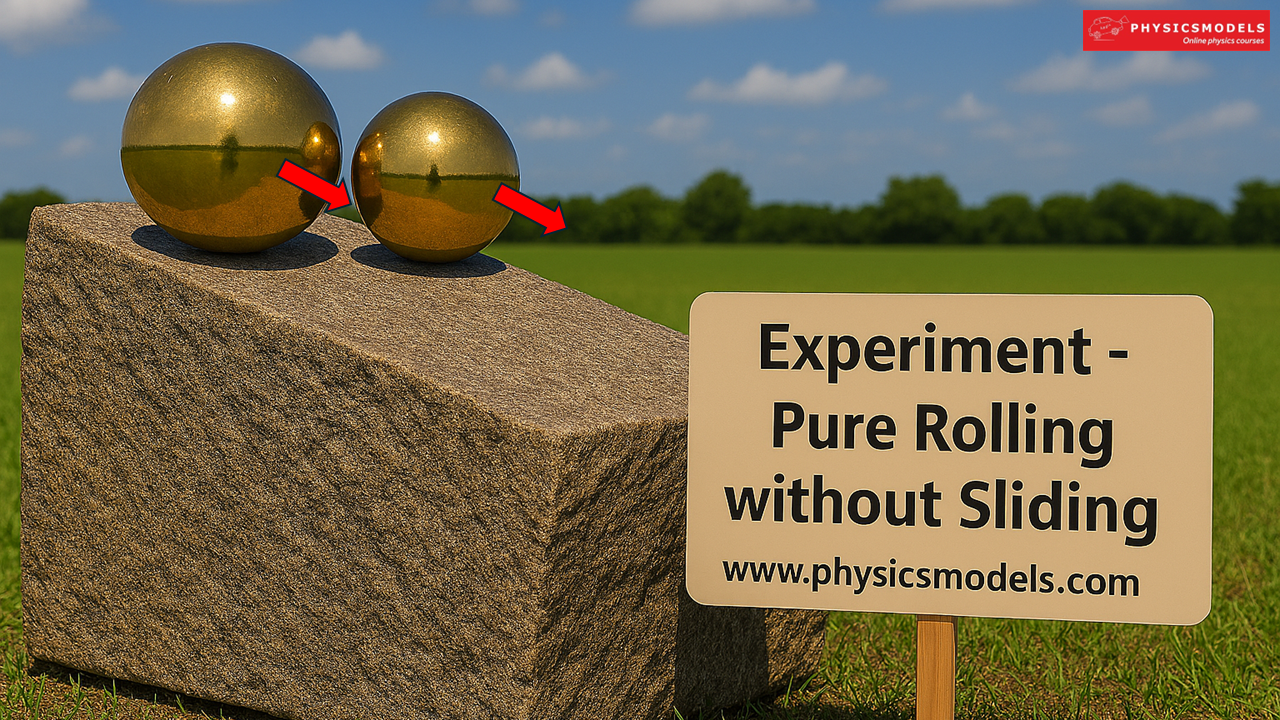
Answer: Use the earlier equation for Linear Acceleration of Centre of Mass. Assuming Pure Rolling without sliding, since all solid spheres will have same Moment of Inertia, both the balls will arrive at the same time at the bottom of the incline. There will be no difference at all in timing.
This is explained also under Solved problem No.5 below
‘Physics Made Easy’ , we trust is working well for you, and we wish that you get high confidence in physics!