Types of Stress and corresponding Strain
What exactly is Stress? Think of pressure (force per unit area) on a cross-section of a solid object. Stress is basically the same, and is used in mechanics of solid materials to describe how they behave when subjected to a Force. Force is also called LOAD many times, so don’t worry.
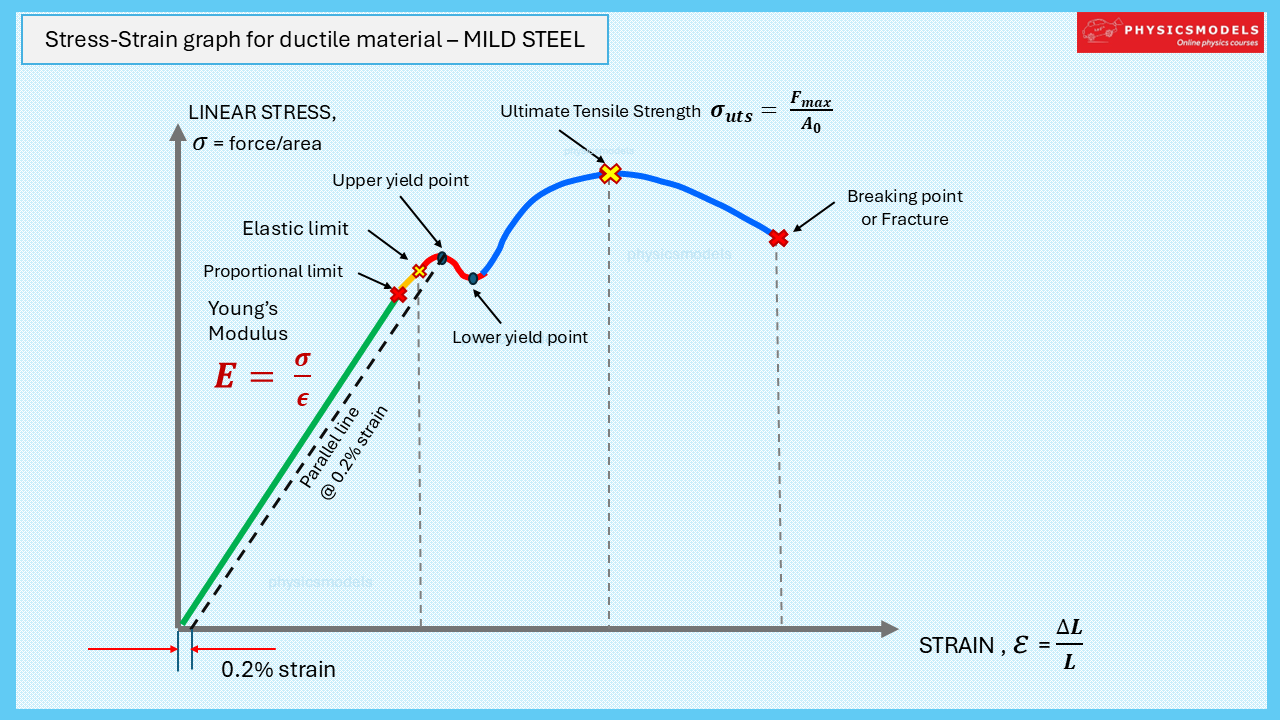
Stress is always used as vertical Y-axis in graphs of stress vs strain. Strain is always used as horizontal X-axis .
Also, when you put Stress , it causes Strain.
There are different types of Stresses.
A) LONGITUDINAL STRESS
- Tensile stress = Tensile Force /Unit area of cross-section
- Compressive Stress = Compressive force/unit area of cross-section
Area of cross-section = π r² in case of round bar or wire. For any other shape, we apply the area as per the geometry.
In 3D model Image below , a case of Longitudinal Tensile Stress and Strain, note carefully that the strong metallic rope is pulling in the direction of elongation, it means the Force is acting in the direction of displacement of the material’s molecules that moved apart from each other (hence the bar became longer).
Does this remind you of “Work done”? We’ll come back to Work Done in a subsequent topic.

3D model image below shows an arrangement, an experiment where you can set up a longitudinal stress-strain. If you pull a rod with a Force at the ends of the rod by making the blocksmove away from each other, basically stress is being applied. This will cause strain , i.e. an increase in length as compared to original length , the rod will elongate if a heavy Force is applied. How much it elongates, will be shown by the Stress-Strain graph above.
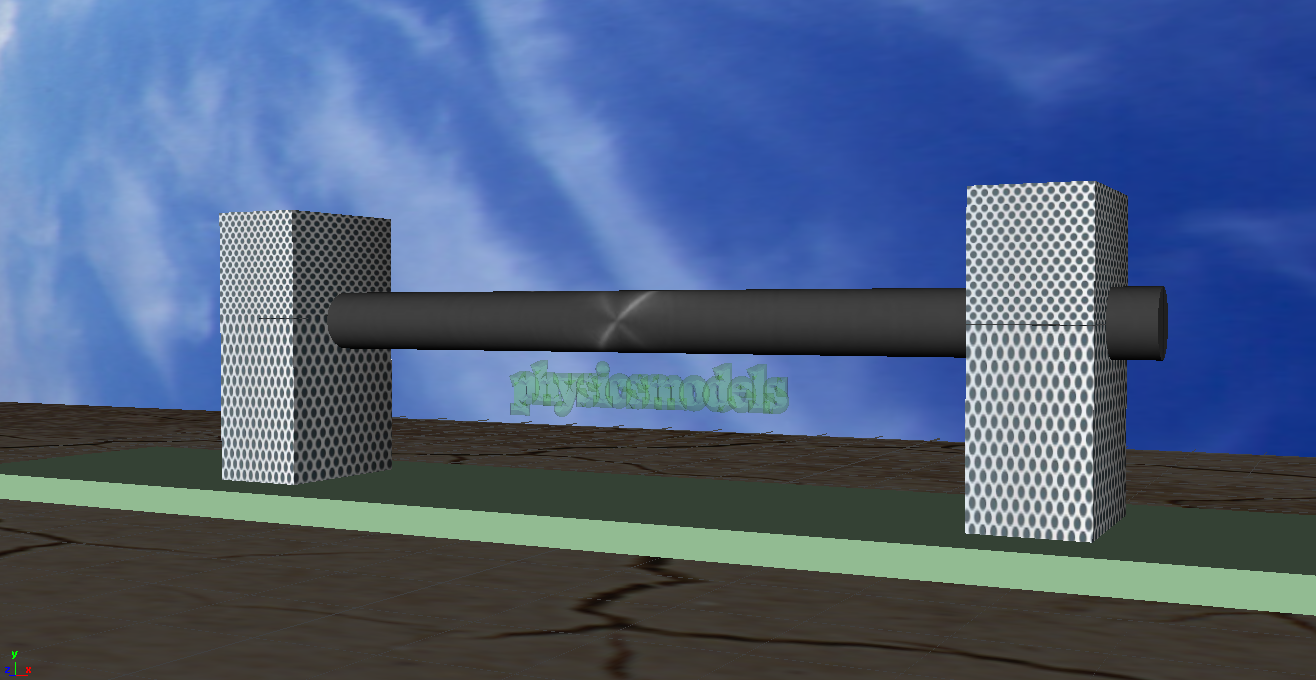
WE will come back to this experiment later in the course.
B) VOLUMETRIC STRESS : example when you immerse something into a liquid .
- If the static pressure inside the liquid at the level of the object immersion is ‘P’, then the Stress is nothing but the Pressure.
- Stress = Pressure = F/A
C) SHEARING STRESS & STRAIN : example when you apply a force TANGENTIAL to a block’s surface while the base of the block is fixed on the ground.
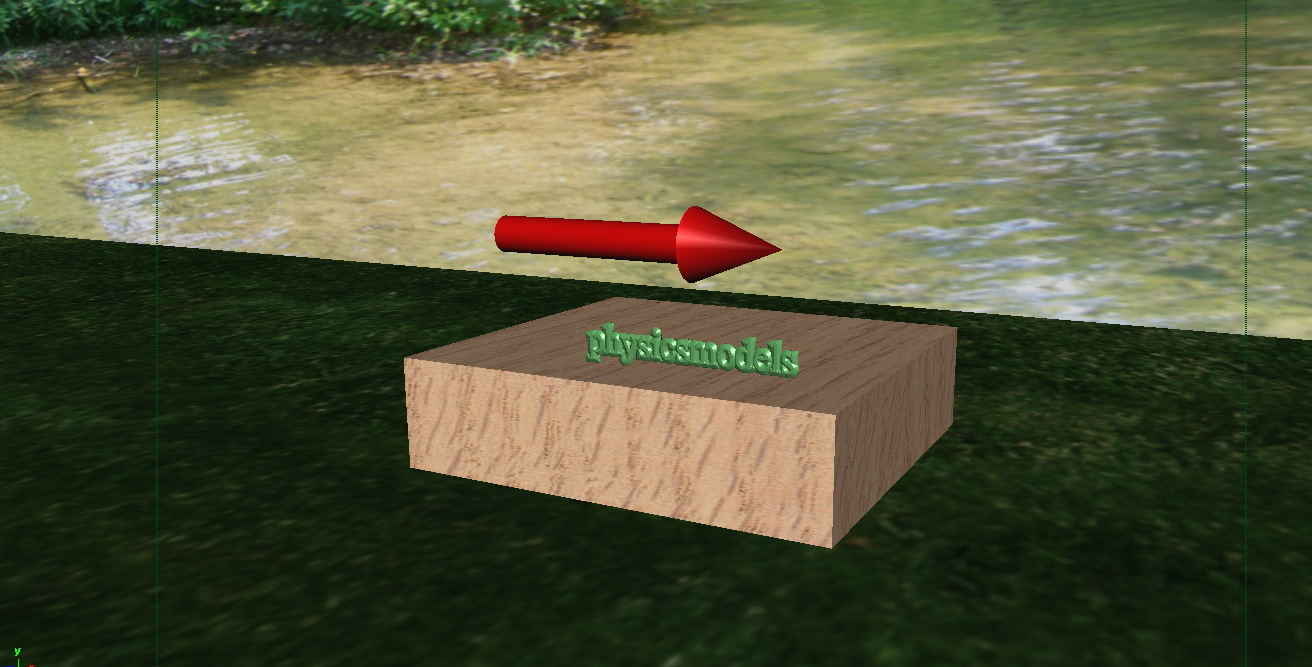
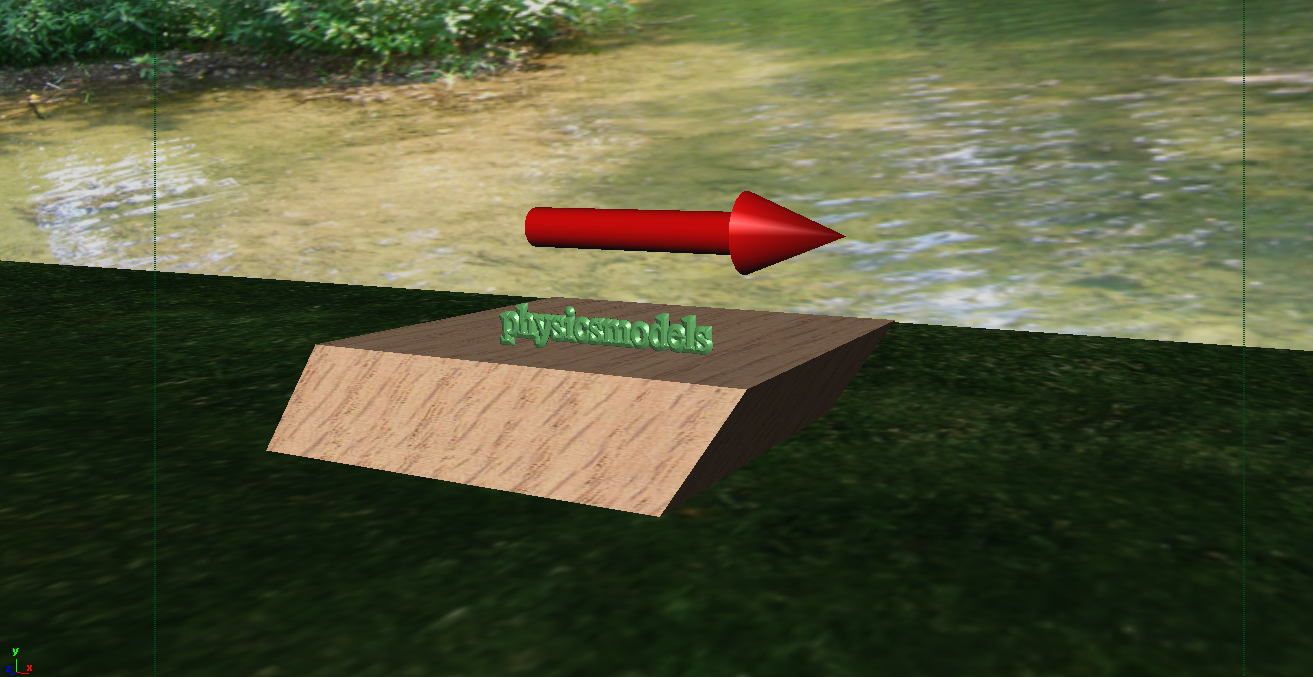
3D model Image below shows initial status of a rectangular block , stationary and fixed on the ground. Force shown by a RED arrow is going to be applied on the block’s top surface , in a direction parallel to the block’s base on the ground. The block itself does not move in Shear.
SHEAR DEFORMATION: 3D model Image below shows after the Shear Force is applied, how the block becomes. The cross-section will look like a trapezoid.
The 2D representation in textbook style is presented here, for a golden block, where a shear force is applied on its entire top surface. Note that ABCD becomes a parallelogram of shape ABC’D’
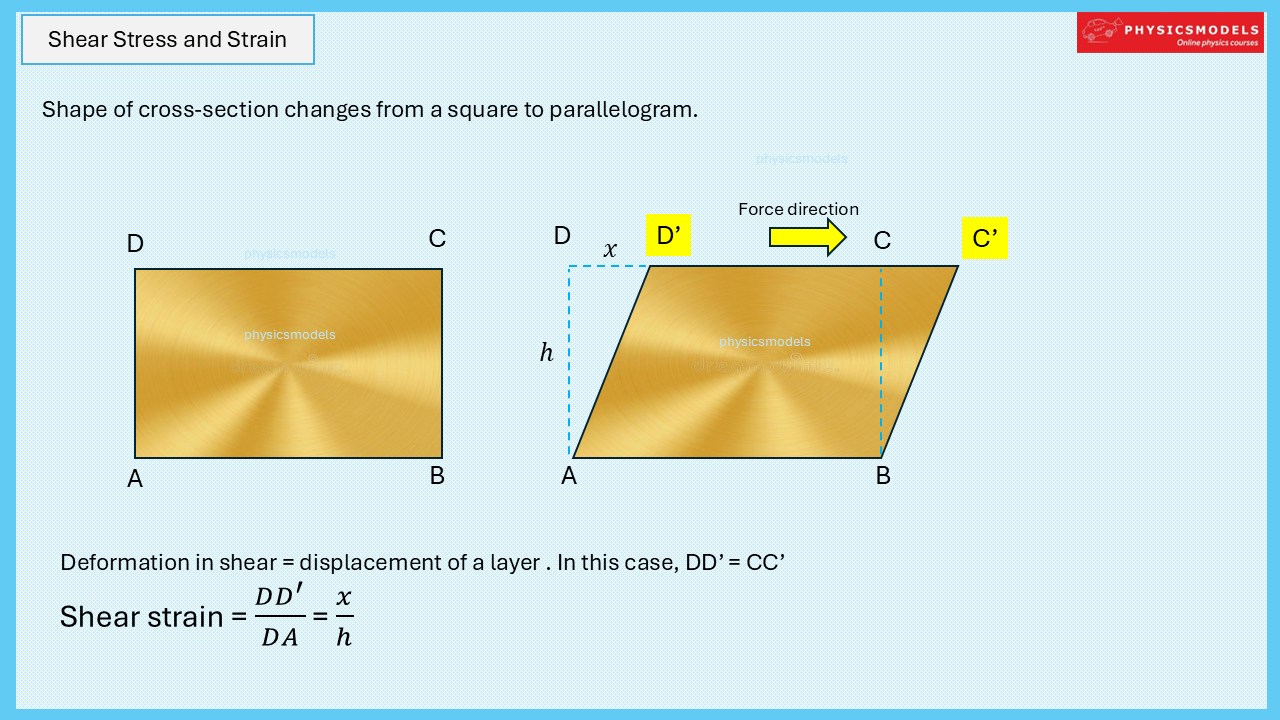
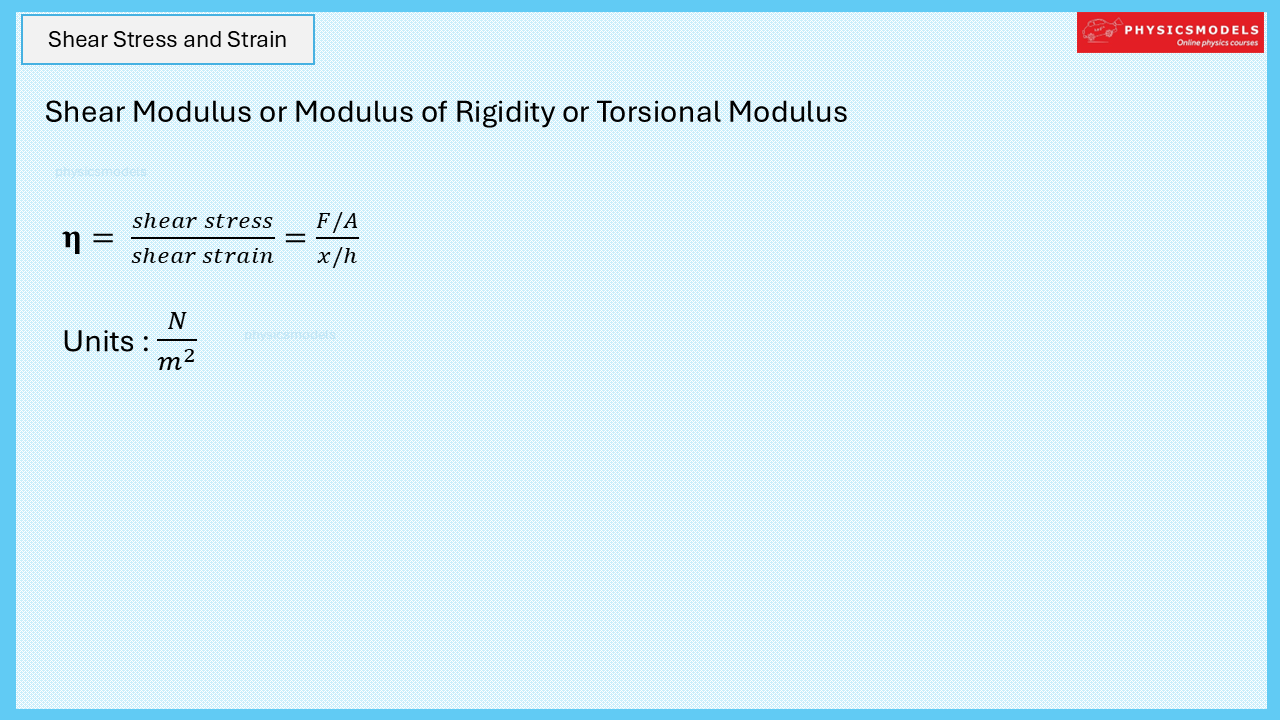
The shear modulus then becomes a ratio like in the other cases.